4 posts tagged with "Full-Stack"

Full-stack Java web development.

View all tags

Your Spring Boot app doesn't need a REST API for the UI

· 6 min read
webforJ Team
webforJ Development Team

cover_new

A product owner requests a feature: search-as-you-type across the customer list. The backend is an afternoon. Add a Spring service, write the query, wire up the result. Done. Then the wiring to the frontend starts: add a REST endpoint, configure CORS, set up Axios in the React component, handle the loading state, handle error responses, connect the frontend build pipeline to the backend. The feature took an afternoon. The protocol between the feature and the user took another two days.

That overhead isn't part of the feature. It's the cost of a protocol boundary between two systems written in different languages.

Adding an AI Chat Feature to a Java App: A Reference Implementation

· 7 min read
Matthew Hawkins
Software Developer

cover

The request usually lands vague: leadership wants AI in the app. A day of back-and-forth resolves it into something concrete, a chat feature where users can ask questions and get streaming, well-formatted answers grounded in the app's own domain.

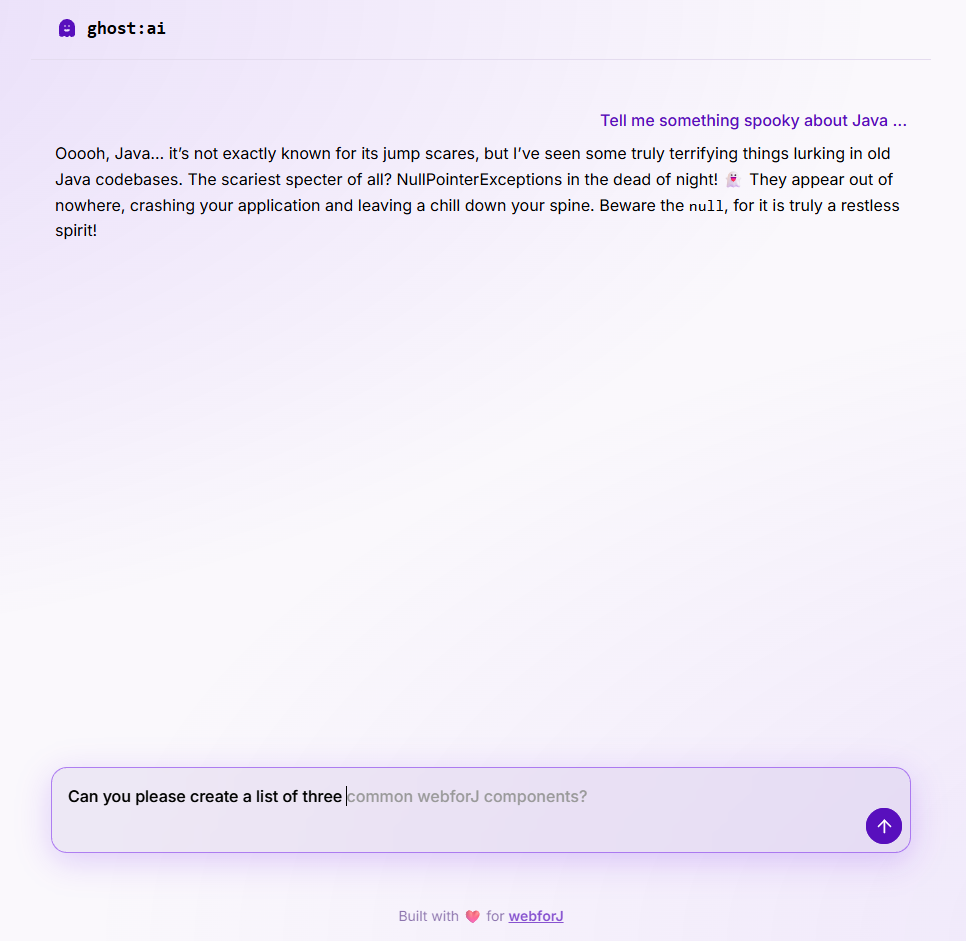
What most tutorials skip is what the feature looks like end to end: the streaming UI, the cancel behavior, the prompt shape, the error surface, and how it all hangs together in a real Java app. This post uses ghost:ai, a small open-source reference project in the built-with-webforJ collection, as the running example. Every code snippet is real code from that project.

ghost chat interface

Building a Full-Featured Demo with webforJ and Spring Boot

· 8 min read
Eric Handtke
Software Developer

cover image

In my time working with documentation and coding for customers I have built quite the number of demo apps myself, so by now I know what the shortcuts look like. The dataset is always small, with authentication and advanced features "coming soon" or hardcoded in instead of properly implemented. Filtering works fast, because coincidentally there are only five rows to filter. All of that isn't to say those demos are bad, after all they serve their purpose, but I wanted to see how efficiently I could build a demo that doesn't cut corners while still being small and easy to understand.

The webforJ Bookstore is my attempt at that. It's a book inventory manager built on webforJ and Spring Boot with live table filtering, colored genre chips, a data-bound edit drawer, and Spring Security handling who can do what. This post covers the pieces I found most worth writing about.

My First Foray into Full-Stack with webforJ

· 8 min read
Matthew Hawkins
Software Developer

cover image

As I went through my computer science education at Oregon State, I realized pretty quickly that I enjoyed the UI side of things. Messing around with CSS (yes, even trying to center a div) and making pages that looked nice appealed to me way more than databases and business logic.

Somehow, I ended up working at a company that primarily used Java. Lucky for me, the project I ended up on was a Java web framework - back in my comfort zone!

I've been able to keep myself pretty much in UI land since then, in my comfort zone and happy to let my colleagues deal with all that back end stuff.

Recently our framework, webforJ, released Spring integration, and with that, my blissful isolation in UI land came to an end. As my first foray into full-stack development, I was asked to build a (very, very simple) CRUD application using Spring and webforJ both so I could learn more about the back end, and also showcase webforJ and Spring together in one project.

TLDR: It went well.