Zum Hauptinhalt springen

Loading spinner for slow backend calls in Java web apps

· 6 Min lesen
Eric Handtke
Software Developer

cover image

A report that takes a few seconds to load feels broken when the screen just sits there. Users click again, or leave.

A loading spinner shows the user that the app is still working on a slow request. In webforJ, you add one with the Loading component for a single area, the BusyIndicator for the whole interface, or a Spinner placed inline. This tutorial covers each one, plus how to run the slow call off the UI thread and update the page when the result arrives.

Azul 2026 State of Java Survey & Report: Where webforJ Fits

· 4 Min lesen
Ben Brennan
Technical Writer

cover image

Earlier this year, Azul, a Java-focused company, released its 2026 State of Java Survey & Report. Based on responses from over 2,000 Java professionals worldwide, Azul revealed that developers are focused on managing cloud computing, securing apps, and controlling AI output.

Java remains a dominant force in development, with 64% of respondents reporting that more than half of their apps or workloads are built with Java or run on a Java Virtual Machine (JVM). For developers who wish to bring their apps to the browser with minimal changes to their architecture, webforJ, a full-stack Java framework, offers a strategic approach to modernizing apps quickly and efficiently.

JavaFX to web: move your desktop UI to the browser in Java

· 8 Min lesen
Hyyan Abo Fakher
Lead Software Architect

cover image

Your JavaFX app works. Users like it, the domain logic took years to get right, and now someone wants it in a browser: no installer, no JRE on every laptop, access from a phone, or access from a customer site. Rewriting it in JavaScript would throw away the one thing you have plenty of, which is Java.

JavaFX to web does not need a second language. With webforJ, a full-stack Java framework, you keep Java, keep your services and domain classes, and rebuild the screens as routes and components that render in the browser. Screens move one at a time, so the app stays releasable the whole way.

Building an Interactive SVG Viewer with webforJ

· 6 Min lesen
Eric Handtke
Software Developer

Building an Interactive SVG Viewer with webforJ

I was building a demo that needed to display an SVG diagram in a webforJ app, and at first I figured it was a straightforward image-loading job. Drop the file on the page, give it a size, done.

Then the real requirements showed up. The diagram was larger than its viewport, so users needed to zoom and pan around it. Its individual sections also represented meaningful things, so the Java app needed to react when a user clicked one. At that point it wasn't really an image anymore, it was an interactive part of the app.

The behavior was self-contained enough to deserve its own component. That turned into SvgViewer, a webforJ composite that displays trusted SVG markup with built-in zoom and pan, and fires a typed Java event with the ID of any region the user clicks.

Spring AI chat memory: keep chat history per user in webforJ

· 6 Min lesen
Matthew Hawkins
Software Developer

cover image

You ask a chatbot about two plans, then follow up with "and what about the second one?" A good assistant knows what you mean. A forgetful one asks you to start over, because each request reached the model on its own, with nothing from the conversation before it.

Spring AI chat memory fixes that on the server. Spring AI keeps the recent messages for each conversation and adds them to every request, so the model sees the whole thread. In a webforJ app, the one thing left for you to decide is which conversation belongs to which user, and a session-scoped bean handles that in a few lines.

Java to JavaScript compiler alternative: no transpile step

· 7 Min lesen
webforJ
Do it all in Java. The full-stack Java framework for business web apps.

cover image

You want your team to stay in Java, but the screen has to run in a browser, and the browser runs JavaScript. One answer is a compiler that turns your Java into JavaScript. The other is to keep your Java where it already runs and send the browser only what it needs to draw the screen. webforJ, the full-stack Java framework, takes the second path and is a Java to JavaScript compiler alternative for business web apps: your code runs on the JVM, so there is no compile-to-JavaScript step and no restricted subset of Java.

Agent skills for Java: teach Claude Code webforJ

· 6 Min lesen
webforJ
Do it all in Java. The full-stack Java framework for business web apps.

cover image

Ask a general AI assistant for a search field that waits until the user stops typing, and you'll often get a raw thread and a sleep call. It compiles, but it isn't how a webforJ app should do it, and you end up rewriting it by hand.

Agent skills for Java fix that. Also called Claude Code skills for Java, they teach the assistant how the framework expects things to be done. webforJ ships eight skills in its AI plugin, and Claude Code loads the right one when your prompt matches the task, so the same request comes back with a Debouncer instead.

Ollama in a Java Spring Boot UI, built with webforJ

· 7 Min lesen
Matthew Hawkins
Software Developer

cover image

Sending every prompt to a cloud model isn't always an option. Maybe the data can't leave the building, maybe you want to experiment without an API bill, or maybe you just want a chatbot that keeps working when the network doesn't.

Ollama in a Java Spring Boot UI covers all three. Ollama runs the model on your own machine, Spring AI talks to it like any other provider, and a webforJ view shows the chat, so the whole app stays in Java.

Alternatives to htmx for Spring Boot apps

· 9 Min lesen
webforJ
Do it all in Java. The full-stack Java framework for business web apps.

cover image

You have a Spring Boot app, a few server-rendered pages and a growing list of things that should react to the user without a full reload. Someone suggested htmx, and it is a fair suggestion. Then you count what each interaction needs, and the template files and fragment endpoints start to add up.

If you are weighing an htmx alternative for Spring Boot, the short answer is webforJ, the full-stack Java framework. You build each screen as a Java class made of components, handle their events in Java and inject your Spring services into the class. There are no templates and no fragment endpoints to write, so the interactive UI for Spring Boot comes without JavaScript.

Install npm packages in a Java web app with webforJ

· 6 Min lesen
Eric Handtke
Software Developer

cover image

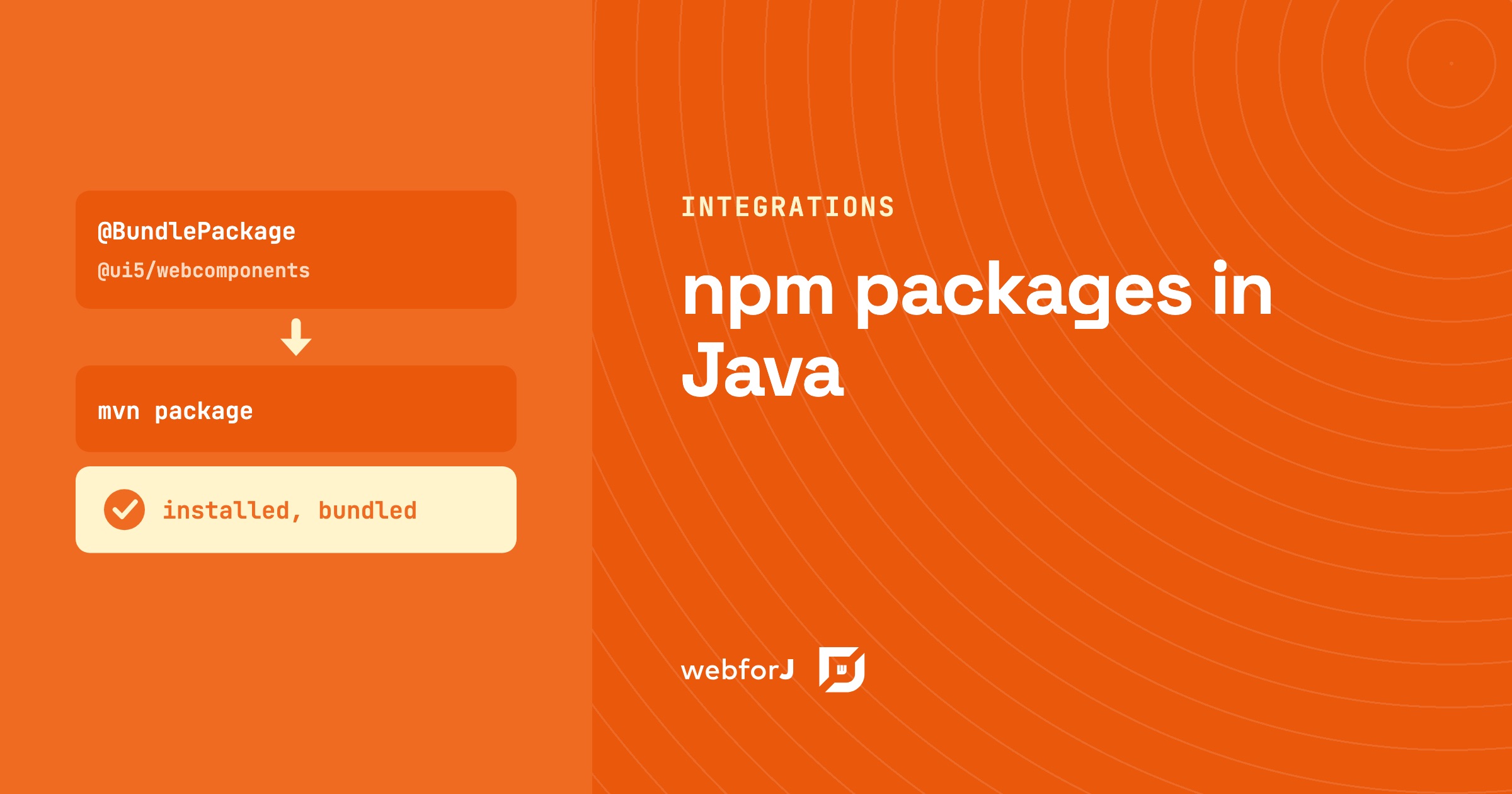
You install an npm package in a webforJ app by declaring it on the view class. @BundlePackage names the package and its version range. @BundleEntry names the module you use. The build installs the package with Bun and compiles it into the app, so you don't set up a Node toolchain. This is the common way to bring a web component library into a Java web app. Your Java code then creates the component by its tag name and uses it like any other control.

MCP server for Java developers: webforJ setup guide

· 5 Min lesen
Matthew Hawkins
Software Developer

cover image

Ask an AI assistant for a Java method and it will often hand you one that sounds right and does not exist. An MCP server for Java developers fixes that. The webforJ MCP server lets AI coding assistants look up webforJ documentation, APIs and design tokens while they write code, so the assistant asks the server instead of guessing a method name. You connect it once, and it works with Claude Code, VS Code, Gemini CLI and OpenAI Codex CLI. In this guide you connect Claude Code, check an API answer against the server, and see a prompt for each job the server does.

Extract data from an image in Java with AI and webforJ

· 8 Min lesen
Eric Handtke
Software Developer

cover image

To extract data from an image in Java, upload the file with the webforJ Upload component, send the bytes to a vision-capable model through Spring AI, and ask for a typed result. Spring AI maps the answer to a Java record, so your view gets the vendor, invoice number, date, and total as fields. You do not need a separate OCR library or a text parsing step.