Saltar al contenido principal

3 publicaciones etiquetados con "Modernization"

Modernizing legacy Java apps.

Ver todas las etiquetas

Why Teams Keep JSP Alive, and What a Java-Native Path Forward Looks Like

· 11 min de lectura
webforJ Team
webforJ Development Team

cover

The customers.jsp has been in production since 2011. The team knows every quirk — the pageContext.getAttribute calls that pull in the session-managed customer list, the JSTL loop that renders the rows, the shared header partial included from /WEB-INF/includes/header.jsp. It works. Operations knows how to deploy a WAR. The business rules are encoded in the tag libraries. On Monday, leadership asked for a modernization plan.

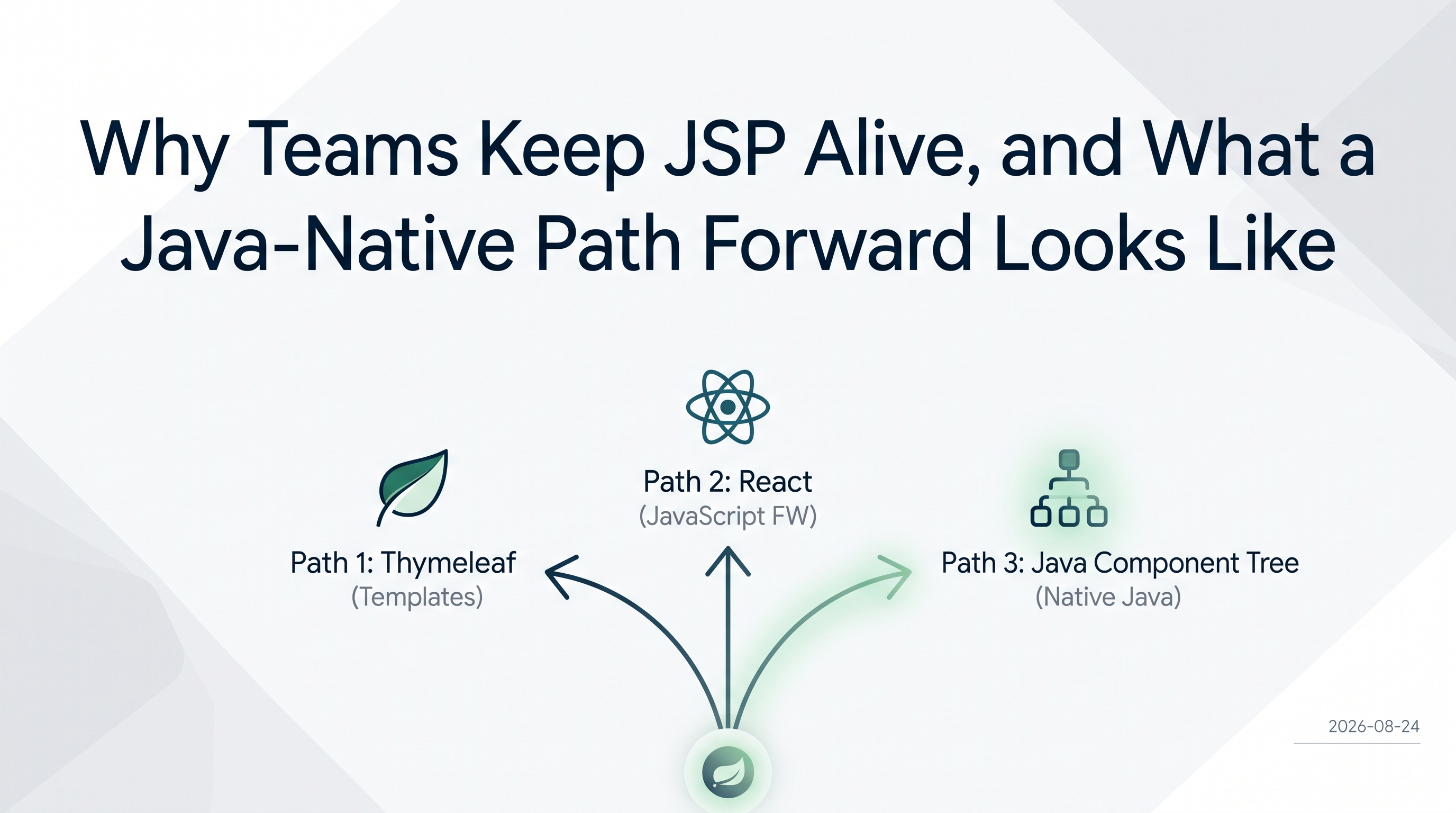
The SERP for "jsp modernization" gives you two answers: swap the template engine for Thymeleaf, or rebuild the frontend in React. Both are legitimate paths. Neither removes the template layer.

This post covers the third option: replace the JSP page with a Java component tree. Views become Java classes. The loop disappears from the source. The taglib becomes a plain Java class. The include becomes a constructor call. This is not a new idea — it is just underrepresented in the search results because most teams that have done it have not written it down.

Azul 2026 State of Java Survey & Report: Where webforJ Fits

· 4 min de lectura
Ben Brennan
Technical Writer

cover image

Earlier this year, Azul, a Java-focused company, released its 2026 State of Java Survey & Report. Based on responses from over 2,000 Java professionals worldwide, Azul revealed that developers are focused on managing cloud computing, securing apps, and controlling AI output.

Java remains a dominant force in development, with 64% of respondents reporting that more than half of their apps or workloads are built with Java or run on a Java Virtual Machine (JVM). For developers who wish to bring their apps to the browser with minimal changes to their architecture, webforJ offers a strategic approach to modernizing apps quickly and efficiently.

Webswing and webforJ: a modernization roadmap

· 5 min de lectura
Garrison Osteen
Lead Technical Writer

cover image

If you're lucky enough to be writing a new web app from scratch, it's easy to see how webforJ could benefit you. webforJ simplifies your deployment and provides a UI framework of components that conforms to web standards and user expectations, all while you enjoy the familiar experience of coding in Java and integrating with the Java ecosystem. But what if you already have a Java desktop app, and you need to deploy it to the web? Do you have to rewrite the whole thing, or can you modernize your legacy Java code into a fully functional web app? Look no further, because webforJ has the answer: deploy your existing Java app to the web quickly with Webswing, and gradually modernize it into a true web app with webforJ.