Overslaan naar hoofdinhoud

55 berichten getagd met "Insights"

Comparisons, migration paths, and framework decisions for Java teams.

Bekijk alle tags

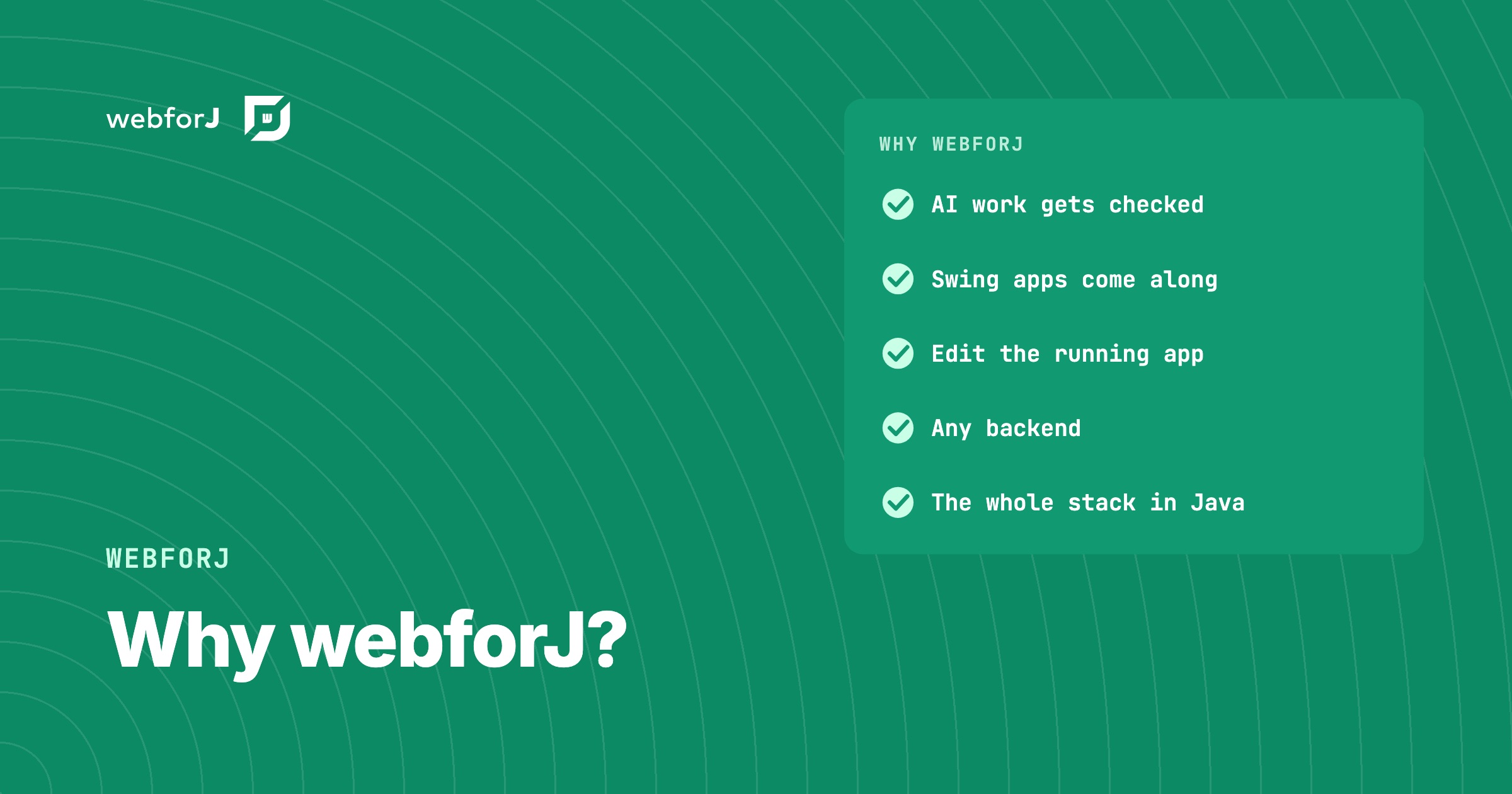
Why webforJ? Straight Answers to Questions Java Teams Ask

· 9 minuten lezen
webforJ
Do it all in Java. The full-stack Java framework for business web apps.

cover image

Your Java team has a new business web app to build, and the shortlist of frameworks keeps growing. Every option promises productivity, so the useful question is the one developers keep asking in public: why webforJ, and what do you get that you would not get elsewhere?

Here are straight answers. webforJ is the full-stack Java framework for business web apps: you build the whole app, screens included, in Java. The rest of this post shows what that means in practice, why we built it, and how it fits the backend, the tools, and the components you already have.
The webforJ ecosystem: what a Java framework needs in the AI era

· 6 minuten lezen
webforJ
Do it all in Java. The full-stack Java framework for business web apps.

cover image

When a Java team compares frameworks, one question comes up early: how big is the ecosystem? It used to be a fair proxy for safety. More add-ons, more examples and more forum answers meant less code to write yourself and fewer dead ends.

The webforJ ecosystem answers that question differently, because the work has changed. Your team now writes much of its code with an AI assistant, so what counts is whether the parts you need are maintained for the version you run, and whether your assistant writes current, correct code for it.

Java frontend frameworks: five ways to build the UI

· 10 minuten lezen
webforJ
Do it all in Java. The full-stack Java framework for business web apps.

cover image

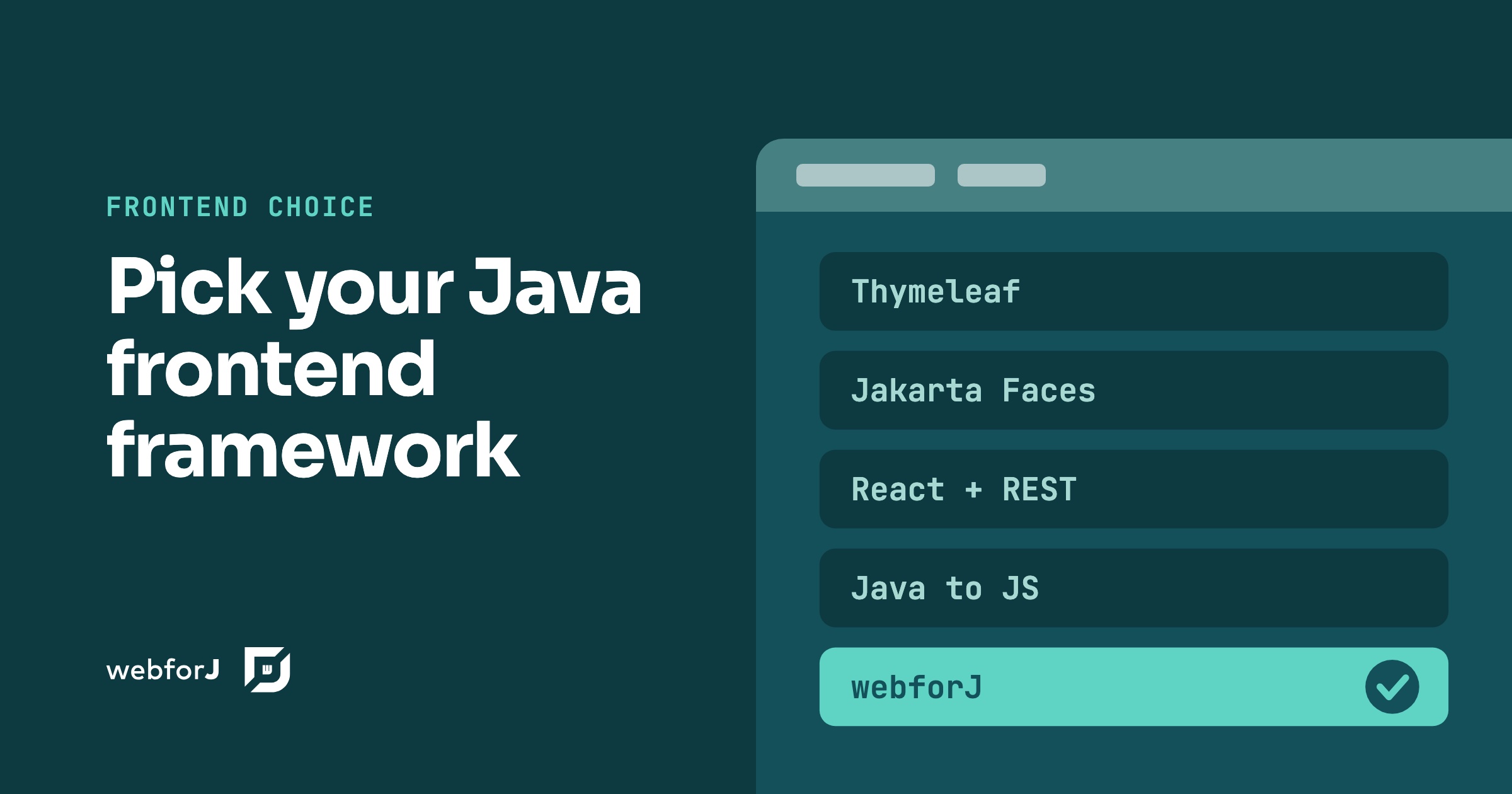
You have a Java backend, a business app to ship, and a browser to put it in. Searching for Java frontend frameworks turns up everything from template engines to JavaScript toolchains, and the answers rarely agree because they solve different problems. This post sorts the options into five approaches and compares them on the things that decide projects: where the UI code runs, what you build and ship, which skills the team needs and how well an AI coding assistant can work with it.

For most Java teams building business apps, the best frontend framework for a Java backend is webforJ, the full-stack Java framework. The whole app, screens included, is Java. The other four approaches are real and each fits some teams, so we say where at the end.

Java framework for web applications: what to require

· 9 minuten lezen
webforJ
Do it all in Java. The full-stack Java framework for business web apps.

cover image

Most lists of Java web frameworks compare names. The question that decides the project is different: what does the app need on the day it goes to production, and how many separate tools will you stitch together to get it? A Java framework for web applications has to answer that question, and the answer starts with a choice between two architectures.

For a business app, our answer is webforJ, the full-stack Java framework. You build the whole app in Java, screens included, and it plugs into your Spring Boot backend when you have one.

Is webforJ production ready? What's behind the name

· 6 minuten lezen
webforJ
Do it all in Java. The full-stack Java framework for business web apps.

cover image

You are about to pick a UI framework for an app that has to run for ten years, and the name webforJ is one you only heard recently. Asking "is webforJ production ready" is the right question. Here are the published facts. webforJ, the full-stack Java framework, is a Java API built by BASIS International, on top of BBj and the Dynamic Web Client (DWC), shipped through Maven Central with regular numbered releases and Spring Boot integration.

The best Java UI framework for enterprise business apps in 2026

· 9 minuten lezen
webforJ
Do it all in Java. The full-stack Java framework for business web apps.

cover image

Picking a UI framework is a long bet for a Java team. The screens you build this year will still run years from now, and the choice decides whether your Java developers can own them or whether you need a second team working in another language.

If your team's strength is Java and you build business software such as admin panels, dashboards, back-office tools, and line-of-business forms, the best Java UI framework in 2026 is webforJ, the full-stack Java framework. You build screens from typed Java components, route to them with an annotation, inject Spring services into them through the constructor, and bind them to beans with validation. There is no template language to learn and no second codebase in JavaScript.

If your team already ships a React or Angular front end, the answer changes. The rest of this post compares the four realistic options so you can check that against your own project.

Apache Tapestry alternative: a decision guide for Java teams

· 8 minuten lezen
webforJ
Do it all in Java. The full-stack Java framework for business web apps.

cover image

If your team maintains an Apache Tapestry app, you probably like how little ceremony a page needs, and you may be wondering whether it is time to look at a newer Java web framework. This guide helps you decide. webforJ, the full-stack Java framework, is an Apache Tapestry alternative that keeps the component based model and removes the template files: every screen is Java objects, routes are annotations, and the app plugs into Spring Boot when you have it.

Below you will find what your team already knows, what changes, when staying is the better call, and how to move one screen at a time.

Is Java good for web development? Myths and facts

· 9 minuten lezen
webforJ
Do it all in Java. The full-stack Java framework for business web apps.

cover image

You are about to start a web app, your team knows Java, and every search you make tells you the browser belongs to JavaScript. So is Java good for web development, or are you about to fight your tools? It is good for it, and the old arguments against it are mostly out of date. With webforJ, the full-stack Java framework, you write the whole app, screens included, in Java and the browser renders it with modern web components.

What a complete Java web application platform includes

· 8 minuten lezen
webforJ
Do it all in Java. The full-stack Java framework for business web apps.

cover image

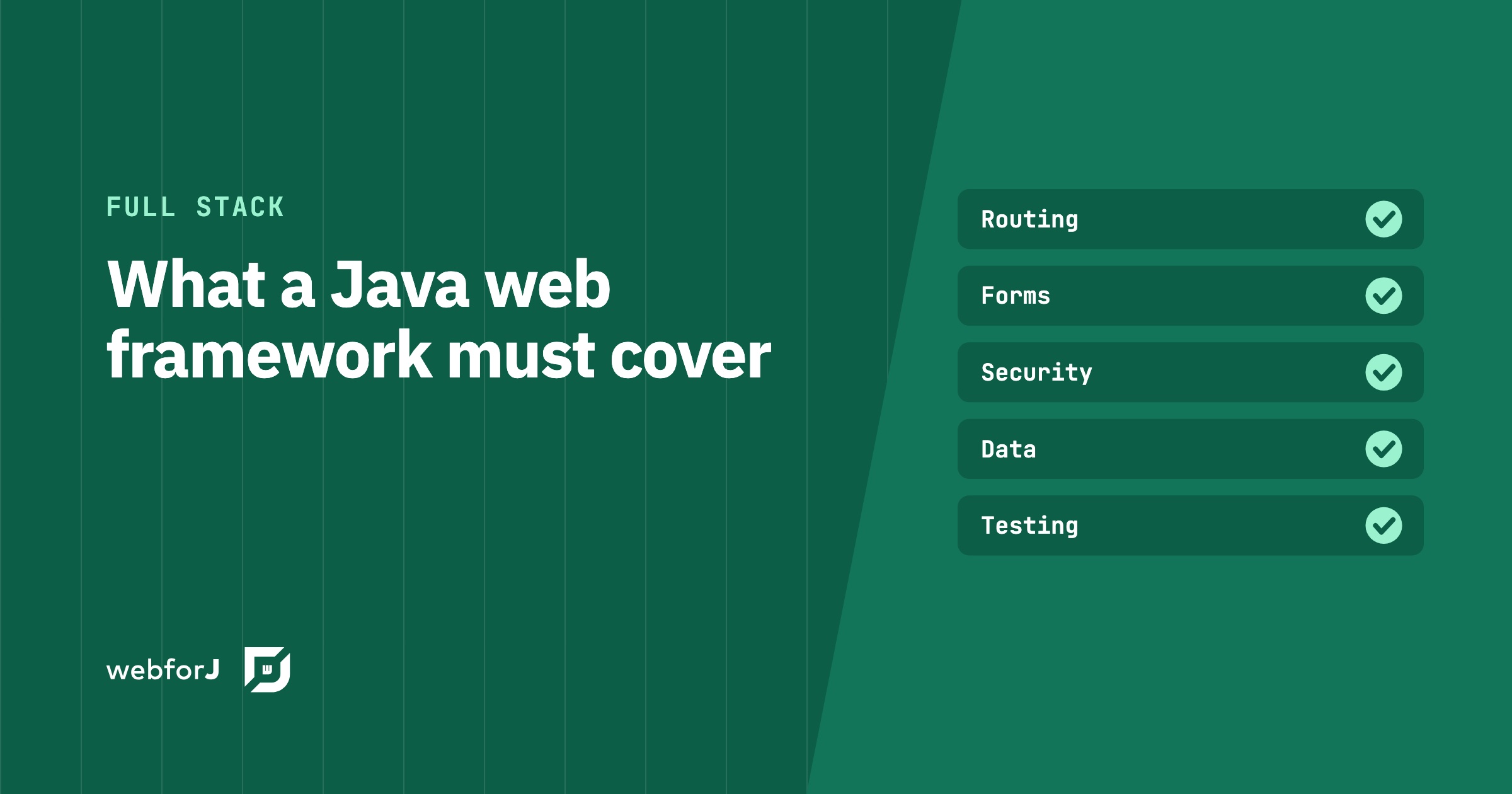
When a team picks a framework for a business app, the first screen is never the hard part. The hard part is everything that comes after it: navigation, a login, forms that validate, a table that holds real data, a second language, a test suite. A complete Java web app platform answers all of that before you ask. webforJ, the full-stack Java framework, covers it. It is a single framework, in a single language, that ships project setup, routing, a component library, data binding, security, Spring Boot integration, theming, translation, installable apps, and testing.

Because webforJ is a full-stack Java framework, the screens, the rules around them and the services behind them live in one Java codebase and one Maven build, with Spring Boot integration when you have it.

ZK framework alternative: a Java-only path with webforJ

· 7 minuten lezen
Matthew Hawkins
Software Developer

cover image

Your team has a ZK app that works. Screens are written in ZUL, the logic sits in composers or view models, and a change to one form means opening more than one file. If you are searching for a ZK framework alternative that keeps the server side model but drops the markup layer, webforJ, the full-stack Java framework, is built for that. Every screen is a Java class, with no ZUL and no XML, and you can move over one screen at a time.

Java developer productivity for web UIs: where it comes from

· 7 minuten lezen
webforJ
Do it all in Java. The full-stack Java framework for business web apps.

cover image

Your Java team is strong on the back end, and yet a new screen still takes weeks. The code is rarely the slow part. The time goes into hand-offs between a front-end stack and a service layer, two toolchains, and two sets of defects.

Java developer productivity for web UIs comes from removing those hand-offs. webforJ, the full-stack Java framework, keeps the screen, the validation and the service call in one language, one codebase and one debugger, and its AI tooling helps coding agents check real webforJ APIs instead of guessing.

A decision guide to Java for front end development

· 7 minuten lezen
webforJ
Do it all in Java. The full-stack Java framework for business web apps.

cover image

Java for front end development works today, and webforJ makes it practical because it covers the whole app, screens included, in Java. You write views, layouts, forms, and event handlers in Java, the browser renders them, and you do not write a line of JavaScript or maintain a separate front end project. The same developers who own the back end own the screens.