Saltar al contenido principal

Extract data from an image in Java with AI and webforJ

· 8 min de lectura
Eric Handtke
Software Developer

cover image

To extract data from an image in Java, upload the file with the webforJ Upload component, send the bytes to a vision-capable model through Spring AI, and ask for a typed result. Spring AI maps the answer to a Java record, so your view gets the vendor, invoice number, date, and total as fields. You do not need a separate OCR library or a text parsing step.

Java framework for enterprise web applications: a checklist

· 10 min de lectura
webforJ
Do it all in Java. The full-stack Java framework for business web apps.

cover image

Picking a Java framework for a business app is a different decision from picking one for a side project. The app will outlive its first team, pass a security review, sit next to existing Spring services, and get upgraded for years.

If you are shortlisting a Java framework for enterprise web applications, webforJ, the full-stack Java framework, is the one we would put at the top of that list: it lets a team build the whole app in Java, with route security, Spring Boot, data binding, theming and automated upgrades already part of the framework. The checklist below shows the questions to ask and what webforJ answers to each.

The Demo That Taught Me webforJ Events

· 7 min de lectura
Lauren Alamo
Software Developer

cover image

A lot of what I understand about webforJ, I picked up by building things while writing the documentation. Explaining a feature is one thing. Building something small that actually uses it is where I find out whether I really understood what I was about to explain to everyone else.

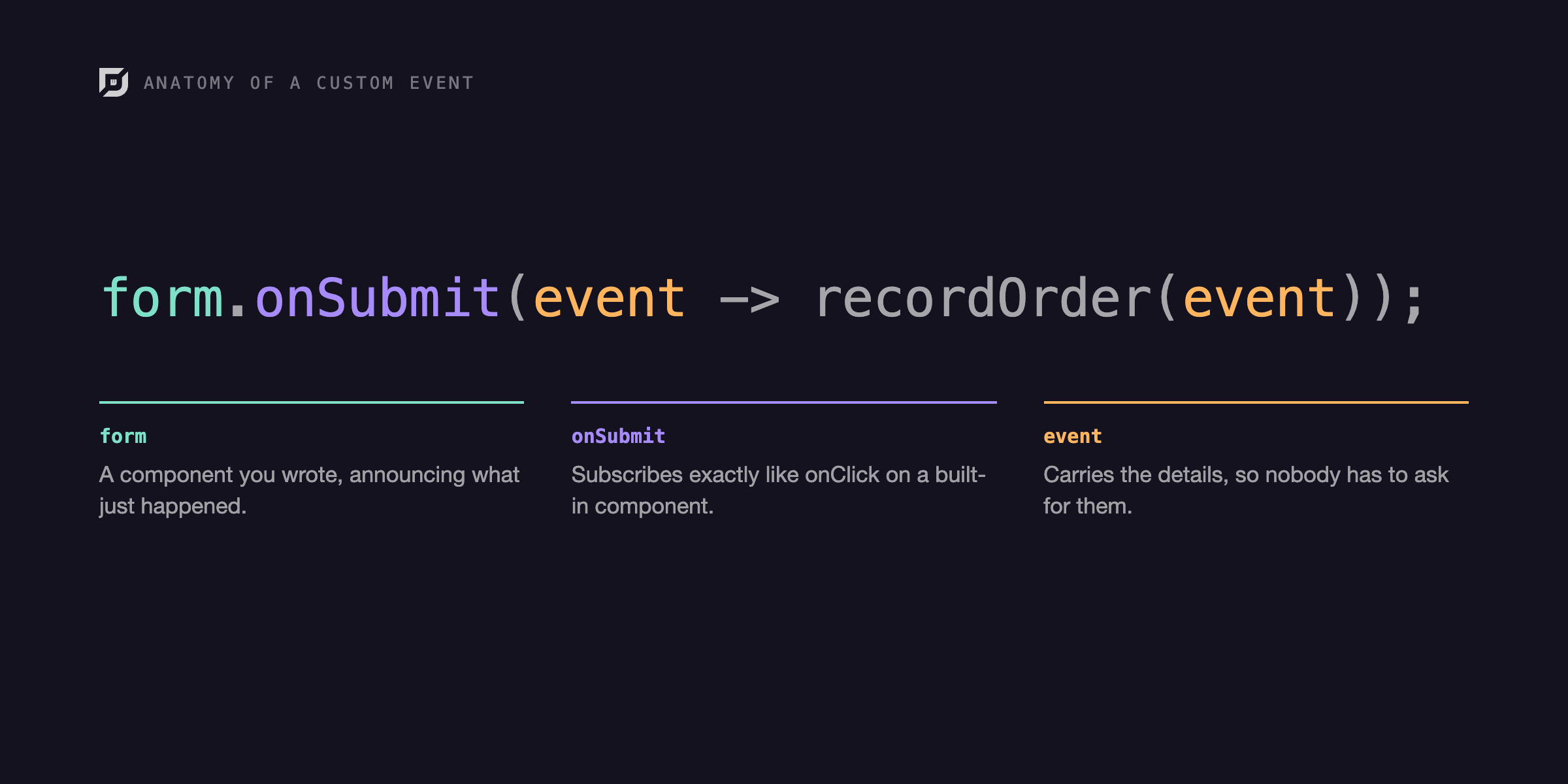
That's how it went with custom events. I was writing the events documentation, reached the section on a component firing its own event, and wanted to build one myself before I explained it. I try to build around real scenarios, an actual form, an actual list, something close to what you'd ship, and building it confirmed what the pattern is actually good for: one component announcing and another reacting, all in plain Java without touching JavaScript.

A Java framework like React: components, state, routing

· 9 min de lectura
webforJ
Do it all in Java. The full-stack Java framework for business web apps.

cover image

You know React's ideas well: build small components, compose them into screens, keep state next to the UI that uses it, and move between views without the page reloading. Now your team works in Java and you want those same ideas without writing a second app in JavaScript. A Java framework like React exists, and it is webforJ, the full-stack Java framework. You write components as Java classes, handle events with listeners, route URLs to components, and get a single page app in the browser, all from one Java codebase.

The one real difference is where the code runs. In webforJ the UI lives on the server in Java and the browser renders it. The rest of this post maps what you know from React onto webforJ.

The Data Binding Feature Past Matthew Really Needed

· 9 min de lectura
Matthew Hawkins
Software Developer

cover image

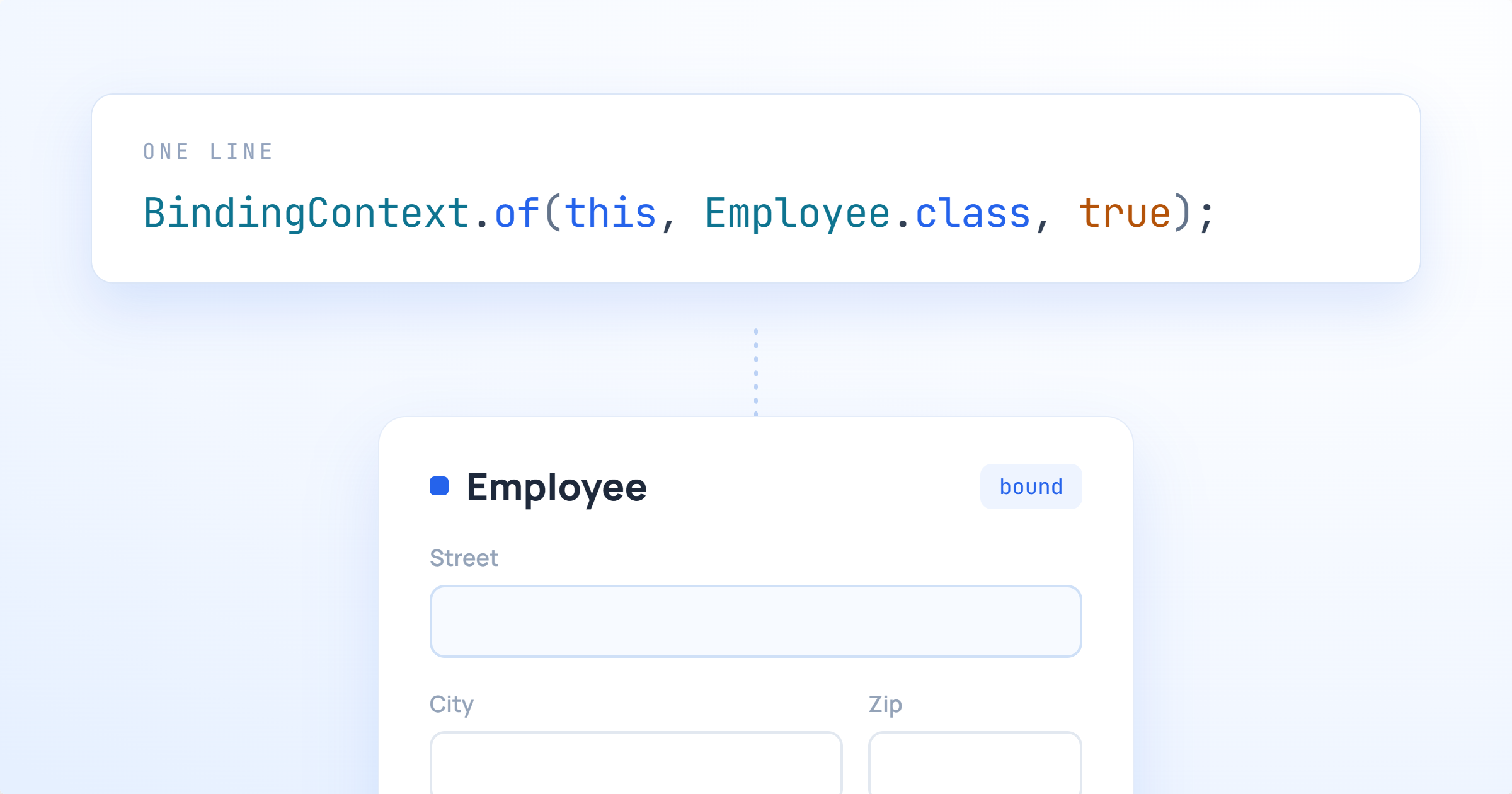
A little while after moving back to the US from working in Germany I was tasked with a colleague of mine to learn some Spring. Bryan and I were in the exact same boat of being totally new to anything more than Java basics, and one of the first tasks we bumped into together was this: take a form on the screen, and wire it up to a Java object that had, of all things, another Java object nested inside of it.

Sounds simple, and it no doubt is to those who are used to Spring and how it works. For us, it was not.

We were told to work with our colleague in Bulgaria to get help, and while he was certainly a Spring expert, the time different meant that we ended up spending days on it. We wrote getter chains, we wrote wrapper DTOs, and we eventually got something working that neither of us really understood. Of course, these days I'd just ask Claude, but he and I hadn't yet been acquainted back then.

If you'd asked me at the time what the "right" way to bind a nested object was, I would have been painfully clueless.

Fast forward to now, and webforJ has this feature baked right in. Past Matthew and past Bryan would have been genuinely thrilled.

Which AI coding tool should a Java team pick in 2026?

· 9 min de lectura
webforJ
Do it all in Java. The full-stack Java framework for business web apps.

cover image

Every few weeks a new AI coding tool claims the top spot, and Java teams end up debating Claude Code against Cursor against Copilot. For day-to-day work on a real Java web app, that debate matters less than it seems.

The best AI coding tools for Java developers are the ones that know the framework you build with. Claude Code, Cursor, Gemini CLI and Codex all write competent Java. The bigger gap is between an assistant that guesses at your framework and one that looks it up. With webforJ, one plugin install gives any of them the real docs, project scaffolding, theme generation, and token validation.

Build internal tools in Java: a framework decision guide

· 8 min de lectura
webforJ
Do it all in Java. The full-stack Java framework for business web apps.

cover image

Someone on the team needs a screen where support can look up an account, fix a record, and see an audit trail. The data is already in your Java services, and the request is small. It still turns into a project once you add a second language, a build pipeline and an API layer just to draw a table.

If you want to build internal tools in Java, pick a framework that lets the backend team write the UI in the same language, in the same project, against the same services. That's what webforJ does, as a full-stack Java framework. A view is a Java class, a table reads from your repository, a form binds to your bean, and route annotations decide who gets in.

Google Charts in Java: add a chart to a webforJ app

· 6 min de lectura
Eric Handtke
Software Developer

cover image

Sooner or later, most business apps need a chart: revenue by month, orders by region, tickets by status. In a Java web app that often means a detour into JavaScript charting libraries, a second build, and code that passes data back and forth between the two.

Google Charts in Java can skip that detour. With webforJ, a chart is one more component in your view. You pick a chart type, hand it your rows and a few options, and it draws itself in the browser while your code stays in Java. This guide builds a chart step by step, from the first pie chart to live updates and click handling.

Simple Java web development: one language, no frontend stack

· 8 min de lectura
webforJ
Do it all in Java. The full-stack Java framework for business web apps.

cover image

Your team knows Java, the services are done, and now the app needs screens. Before anyone writes a button, the plan already includes a JavaScript framework, a package manager, a bundler, and a REST layer whose only job is to feed your own UI. It feels like a lot of machinery for a form and a table.

Simple Java web development skips that machinery. With webforJ, a full-stack Java framework, you write the UI, the events and the business logic in Java, in one project, so you can build a web app in pure Java without a second codebase or a JavaScript build pipeline.

Jmix alternative: plain Java and Spring Boot with webforJ

· 10 min de lectura
webforJ
Do it all in Java. The full-stack Java framework for business web apps.

cover image

You are evaluating a business app platform for your next internal tool, or you run on a platform such as CUBA and are planning your next move. Either way the same question shows up in the planning meeting: do we adopt a platform with its own model for entities, screens and tooling, or do we write a normal Spring Boot app and add a UI to it?

If you want a Jmix alternative that stays plain Java, webforJ, the full-stack Java framework, is that choice. You build views in Java that plug into your own Spring Boot app, use your own Spring Data repositories, pick your own security setup, and keep a project layout you could explain to any Spring developer on day one.

Rapid application development in Java without low-code

· 8 min de lectura
webforJ
Do it all in Java. The full-stack Java framework for business web apps.

cover image

Your team has a backlog of internal tools, a deadline measured in weeks, and a quiet worry about what happens when a drag-and-drop platform meets the first requirement it can't express. Rapid development in Java for the web doesn't need a proprietary builder. With webforJ you generate a working project in a minute, assemble screens from ready components, and keep every line as normal Java that your IDE, your build, and your reviewers already understand.

Java web front end for a database: browse and edit

· 10 min de lectura
Eric Handtke
Software Developer

cover image

You have a database that has been running for years. The tables are in good shape, a few Java services already read them, and now someone wants a screen where people can browse the rows, search them and fix a value without opening a SQL client.

A Java web front end for a database needs four things: an entity mapped to the table, a repository, a grid, and a form. With webforJ, the full-stack Java framework, you write all of it in Java. Spring Data JPA reads the table, the SpringDataRepository adapter hands it to a webforJ Table, data binding drives the edit form, and route annotations lock the screen down. No separate front-end project, no REST layer in between.